
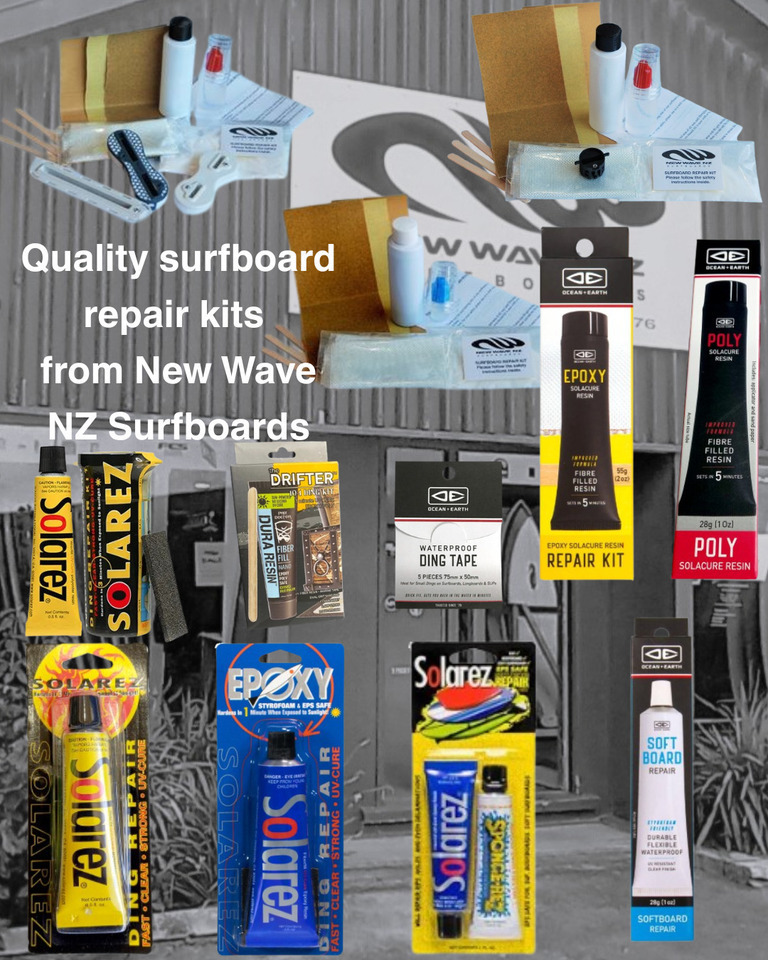
Quality Surfboard Repair Kits from the Surfboard Experts
When it comes to fixing your board, trust the people who build them.
At New Wave NZ Surfboards, we manufacture surfboards right here in Gisborne New Zealand & have been repairing boards for over 50 years, so we know exactly what it takes to get your board back in the water.
Whether you need one of our premium New Wave repair kits—packed with the same quality materials we use in our surfboard construction—or if you're after a quick, easy fix with a ready-to-use repair solution, we've got you covered.
When & Why to Repair Your Surfboard: A New Wave Guide
A few bumps, pressure dents and battle scars are part of owning a surfboard. But how do you know when a ding is just cosmetic — and when it needs to be repaired before it turns into a much bigger problem?
At New Wave NZ Surfboards, we’ve been making and repairing surfboards for decades, so we know that getting on top of a small ding early can save you time, money and potentially a broken board later on.
Not every mark on your surfboard requires immediate attention. Pressure dents and small indentations are common, particularly on the deck where your heels, knees and feet put pressure on the board.
If the fibreglass hasn't cracked and the foam underneath hasn't been exposed, these types of dents are generally cosmetic rather than a serious problem. Heel dents on the deck and small pressure dents on the bottom of the board are often nothing to worry about And let's be honest — once you've put a layer of surf wax over them, most of them disappear anyway!
The Dings You Shouldn't Ignore
The repairs that really matter are cracks or holes that have broken through the fibreglass and allowed water to reach the foam core.
A simple way to check a crack is to carefully run your fingernail across it. If your nail catches on the edge of the crack, it's time to take action.
Once water gets into the foam, it can lead to further damage and cause the fibreglass to separate from the foam. What started as a small ding can then become a much larger and more expensive repair.
Our advice? If you're unsure, repair it sooner rather than later.
A small ding is much easier to repair than a waterlogged board or a board that's started to delaminate.
Surfboard Repair Do’s & Don’ts: Avoid Turning a Small Ding Into a Big Repair
When it comes to surfboard dings, a little damage doesn’t always mean a big repair bill. But there are a few common mistakes we see in the New Wave repair shop that can turn a simple ding into a much bigger job.
Here are some of our biggest surfboard repair do’s and don’ts.
❌ DON’T Stuff Wax Into a Ding
We’ve seen it plenty of times: you get a ding, reach for the nearest bit of surf wax and pack it into the hole to keep the water out.
Don’t do it!
Wax doesn’t create a proper watertight seal, so water can still find its way into the board. Even worse, wax sticks to the foam core and has to be removed before a proper repair can be carried out.
That usually means more sanding, more time and ultimately a bigger, more expensive repair. Wax also has a special talent for clogging up sanding pads!
If you’ve got a ding, keep the wax well away from it and get it repaired properly. It's always good practice to keep a backup board with you, if this isn't an option some ding tape will do a reasonable temporary repair to save your session.
❌ DON’T Try to Suck the Water Out
Another one we occasionally see is surfers trying to suck water out of a ding.
Please don’t!
The materials and chemicals used during surfboard manufacturing are not designed for human consumption. Your surfboard might need a repair, but your mouth definitely doesn’t need to be part of the repair kit!
❌ DON’T Leave Your Board Baking in the Gisborne Sun
We’re lucky to have plenty of sunshine here in Gisborne, but when it comes to drying out a damaged surfboard, direct sunlight is not your friend.
It can get seriously hot in the middle of summer, and excessive heat can potentially cause problems such as delamination, particularly if the board is left sitting in the sun for an extended period.
Instead, place your board somewhere dry, shaded and well ventilated, such as a garage or workshop. Stand it up with the damaged area facing down and allow any trapped water to drain naturally.
This is especially important with epoxy surfboards, which need to be completely dry before starting a repair.
✅ DO: Let Your Board Drain Properly
If your board has taken on water, give it time to drain before attempting a repair. Keep it out of direct sunlight and somewhere with good airflow.
PU vs Epoxy: What Type of Surfboard Do You Have?
If your embarking on your own repair, before you grab the repair kit, it's important to know what your surfboard is made from.
Most surfboards have a foam core surrounded by a fibreglass and resin shell, but the combination of foam and resin can vary.
The two most common constructions you'll come across are PU (polyurethane) and EPS/epoxy.
PU Surfboards
Traditional PU surfboards are made from a polyurethane foam blank and are usually glassed with polyester resin.
For a PU board, polyester resin is generally the best choice because it matches the original construction of the board.
If you're repairing a PU surfboard, make sure you know exactly what you're working with before choosing your resin.
Use: Polyester resin
Alternative: Epoxy can sometimes be used as an emergency repair, but it isn't the ideal long-term solution. A temporary epoxy repair may need to be removed and properly repaired with polyester resin later.
Epoxy Surfboards
Many modern surfboards use EPS (expanded polystyrene) foam with epoxy resin.
If your board is an EPS/epoxy construction, you must use epoxy resin for repairs.
Never use polyester resin on an EPS/epoxy surfboard.
Polyester resin can react with and damage EPS foam, while it also doesn't provide the correct bond to cured epoxy fibreglass.
If you're unsure about your board's construction, it's always better to stop and check before starting the repair. Feel free to get in touch or pop in and see us instore if you aren't sure.
When Should You Get a Professional to Repair Your Board?
DIY repairs are great for many everyday dings, but some repairs are better left to an experienced surfboard shaper or repairer.
We recommend bring your board in for us to repair for jobs such as:
- Large areas of delamination
- Damage that extends deep into the foam
- Broken/ creased boards
- Broken stringers
- Major rail damage
- FCS or Futures damaged boxes with large areas of delamination
- Extensive fibreglass damage
- Repairs requiring colour matching
- Glossing and polishing
- Complex structural repairs
- Boards that have extensive water damage, especially once it hits the stringer.
If you're new to surfboard repairs, don't be afraid to know your limits. Sometimes trying to save a few dollars with a DIY repair can turn a straightforward repair into a much bigger job.
At New Wave NZ Surfboards, we can help assess the damage and advise whether it's something you can tackle yourself or whether it's best left to a professional.
What sort of repair product should I use?
At New Wave we stock a wide variety of repairs kits depending on the sort of repair you need or your skill level.
The easiest repair products are ones that include the fibreglass in the tube with the resin. They are premixed ready to go, they don't require any mixing and the curing time is pretty quick, about 5mins in the sun. These products are ideal for smaller dings or to take as a travel repair product if your board needs an emergency repair to get you back out in the water. Make sure you chose the correct product for your board glassing, either epoxy or polyester (PU). These are a couple of our favourite brands Ocean & Earth UV Solacure Epoxy or Solacure PU. Or Solarez Epoxy UV Cure or Solarez Polyester UV Cure. Another great quick repair product is the FCS simple repair patch which is a lightweight fibreglass patch infused with the resin, it come in both epoxy & pu and two sizes. See more here
If you want a more professional & thorough repair then look no further than our own New Wave surfboard repair kit.
Available in both Epoxy and Polyester resin, our kits come with a choice of 4oz cloth, ideal for most shortboards, or 6oz cloth, commonly used on fishes, mid-lengths and longboards.
We’ve supplied hundreds of repair kits to surfers throughout New Zealand, with great feedback on how easy they are to use and the professional finish they achieve.
What makes our repair kits different? They contain the same quality materials we use to build our own New Wave surfboards. So you’re not just getting a basic DIY repair kit—you’re getting the right materials to help you achieve a strong, clean and professional-looking repair.
Each kit includes easy-to-follow, step-by-step instructions and everything you need to get your board back in the water and looking its best.
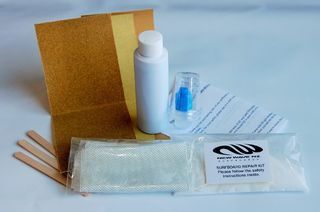
Try one of our own New Wave repair kits for a professional finish .
New Wave NZ Surfboard Repair Tips
Before you start your next DIY repair, keep these tips in mind:
1. Protect Yourself
Always wear appropriate protective equipment, including gloves, safety glasses, suitable clothing and appropriate respiratory protection when working with resins, solvents and fibreglass.
2. Preparation Is Everything
Don't mix your resin until you're ready to work. Resin works very differently from the middle of our hot Gizzy summer to the middle of our cold winters.
Have everything prepared first — mask the area, clean and sand the repair, cut your fibreglass and have your tools ready. Once the resin and hardener are mixed, the clock is ticking!
3. Use the Correct Resin
PU + polyester = the traditional combination.
EPS/epoxy + epoxy = the correct combination.
Never use polyester resin on an EPS/epoxy surfboard.
4. Measure Your Resin and Hardener Carefully
Follow the instructions and measure accurately. Temperature and humidity can have a big effect on curing times.
Warmer conditions can make resin cure faster, while cold conditions can significantly slow the curing process.
5. Use Suitable Mixing Containers
Not every plastic container is suitable for mixing resin. Some plastics can soften or melt when exposed to certain resins, particularly polyester resin.
Always use containers recommended for the product you're working with.
6. Know When to Call the Experts
A small ding is one thing. A broken board, damaged fin box or major delamination is another.
If you're unsure, ask a professional before you start cutting, sanding or glassing.
.
When Is It Time for a New Surfboard?
Unfortunately, not every board can be saved.
A major break, extensive delamination or severe water damage can sometimes make a repair uneconomical. Older PU surfboards can also become increasingly brittle over time as the fibreglass ages, yellows and loses some of its original strength.
If your board has reached the point where every surf seems to result in another repair, it might be time to retire it from the lineup and start looking for your next board! If it's a board you love, have a chat with us about recreating your favorite board.
Choose from our large range of ready to go surfboard repair kit products

Posted: Wednesday 19 August 2026